
Water Heater Relief Valve Leaking: Causes and Code Rules
Updated
Get a free quote
A licensed plumber replies with a price. Nothing is booked until you say yes.
Rather talk? Call (608) 927-6750 or text us.
Short answer
Part of Tankless Water Heaters.
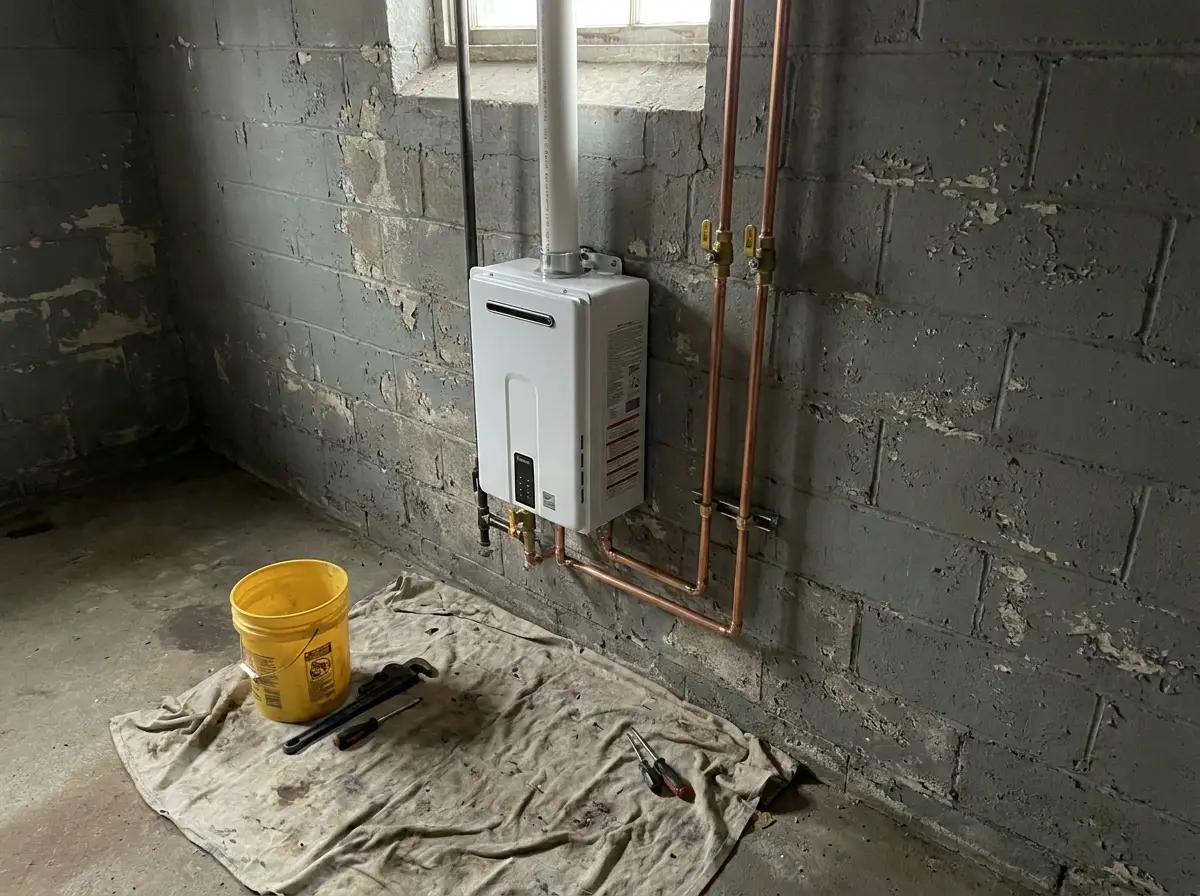
The relief valve is the safety device on a tank water heater. If one is dripping, it is doing its job or it has failed, and either way the fix belongs with a licensed plumber. The rules below also apply when a new unit goes in, so they are worth reading before any water heater installation quote. A tankless unit has no storage tank, so the tank rules here apply to tank-style heaters.
What the relief valve does
Wisconsin's plumbing code requires all pressurized storage-type water heaters and unfired hot water storage tanks to carry one or more combination temperature and pressure relief valves (SPS 382.40(5)(d)). The valve opens when the water in the tank gets too hot or the pressure climbs too high, and lets water out through a pipe so the tank is not stressed beyond its limits.
Why a relief valve drips
A few general causes account for most drips:
- Pressure. If the supply pressure is high, the valve may open in small bursts. See the high water pressure guide.
- Thermal expansion. Heated water takes up more room. In a closed system the extra volume has nowhere to go and can push the valve open each time the heater fires. See the expansion tank guide.
- Temperature. A faulty thermostat or element can overheat the tank.
- A worn valve. Mineral buildup can keep a valve from seating. Beloit water is hard, at 16 to 23 grains per gallon (2024 water quality report), which is one reason valves can foul over time.
A plumber can tell these apart by checking pressure, the thermostat and the valve itself. A constant stream or steam means stop and call right away.
The Wisconsin code for the valve
Under SPS 382.40(5)(d), the valve must be rated at or above the heater's BTU input. No shutoff valve may sit between the heater and the relief valve. The sensing element must monitor the top 6 inches of the tank (SPS 382.40(5)(d)). That is why the valve sits at or near the top.
Rules for the discharge pipe
The pipe that carries water away from the valve has its own rules in the same section:
| Rule | What the code says |
|---|---|
| Size | Same size as the valve outlet or larger |
| Trap | May not be trapped |
| Valves | No valve may be installed in the discharge pipe |
| Slope | Drains by gravity to a floor drain or receptor |
| End point | Ends within 6 inches of the floor or receptor |
| Outlet | Not threaded |
| Location | Ends in the same room as the heater |
These come straight from the state code. A threaded outlet is a red flag because someone could screw a cap onto it. A capped valve cannot relieve pressure, which is the danger the code is trying to prevent.
South Beloit, Rockton and Roscoe
Illinois has its own rule. Under 77 Ill. Adm. Code 890.1230, every water heater must have a pressure relief valve and a temperature relief valve, or one combination pressure and temperature valve, when it is installed (Section 890.1230). Homes in South Beloit, Rockton and Roscoe follow that rule. A plumber working there must hold an Illinois license, as the license check guide explains.
What a repair usually costs
A water heater repair, which covers thermostats, elements, valves and similar fixes, typically runs $150 to $750 in national cost guides (Angi plumber cost guide). A valve swap sits at the low end, while a heater that has to be replaced costs more. The plumber cost page has the full list, and a written quote should say whether a new discharge pipe is included.
What to do while you wait for a plumber
A small drip is not an emergency, but a few steps keep it from getting worse. Place a bucket under the discharge pipe or make sure it reaches a floor drain. Turn the heater's temperature setting down a notch if you can reach it, which can slow a drip caused by heat. Keep children and pets away from the discharge pipe, because the water can be hot enough to scald.
Do not test the valve by lifting its lever unless a plumber tells you to. A valve that has been sitting for years can stick open after a test and begin to drip for good. A plumber tests it during service when a fresh valve is on hand.
Replace the valve or the heater
If the tank is sound, a new relief valve is a short job and often costs far less than a new heater. If the tank has rust at the base, wet insulation or a puddle that is not coming from the valve, the heater may be at the end of its life. A plumber who sees both a failing valve and an old tank will usually say so, and ask whether you want a quote for each. The water heater permits guide covers what the City expects when a heater is replaced.
Questions to ask when a plumber replaces the valve
- Is the new valve rated for the heater's BTU input?
- Does the discharge pipe meet the code, with no trap, no valve and a plain outlet?
- Did you measure house pressure, and is an expansion tank needed?
- Does the job need a permit, and who files it?
A plumber who answers these in plain words and puts the answers in writing has looked at the whole system, not only at the part that drips. That is the difference between a repair that holds and one that comes back in a few weeks.
When to call a plumber
- The valve runs steadily or keeps coming back after you wipe it dry.
- You see steam, scalding water or a rumbling tank.
- The discharge pipe is capped, threaded, trapped or ends somewhere odd.
- The heater is old and the tank base shows rust or moisture.
Do not plug the valve and do not tape over the pipe. Shut off power or gas to the heater if you can reach the control safely, then call. If the heater is due for replacement anyway, see the sizing guide and send the details through the quote form.
Want a price for your own house?
Call, text, or send the form. You get a price back before any work is scheduled.
Quick answers
Why is my water heater relief valve dripping?
Common causes are high supply pressure, thermal expansion in a closed system, an overheating tank or a worn valve. A plumber can test pressure and the thermostat to find which one it is.
Can I cap or plug a leaking relief valve?
Capping defeats the purpose of the valve, which is to release pressure before the tank is stressed. Wisconsin code requires the discharge pipe to have no valve and a non-threaded outlet for that reason.
Where should the discharge pipe end?
It ends within 6 inches of the floor or a receptor, in the same room as the heater, and drains by gravity without a trap. It must be the same size as the valve outlet or larger.
How much does it cost to fix a water heater valve?
Water heater repairs typically run $150 to $750, depending on the part. See the cost page for other jobs and what changes a price.
Is the rule different in South Beloit or Rockton?
Illinois uses 77 Ill. Adm. Code 890.1230, which requires a pressure relief valve and a temperature relief valve, or one combination valve, on every water heater at installation.
Does a tankless water heater have a relief valve?
The Wisconsin tank rules in SPS 382.40(5)(d) apply to pressurized storage-type heaters. A plumber will tell you what a specific tankless model needs under its installation instructions and the code.
Want a plumber to look at it?
Describe the problem and the town. A licensed plumber replies with a price before any work starts.
Prices and the full service list are on the homepage for a plumber in Beloit.