
Galvanized Pipes in Old Beloit Homes: What to Know
Updated
Get a free quote
A licensed plumber replies with a price. Nothing is booked until you say yes.
Rather talk? Call (608) 927-6750 or text us.
Short answer
Part of Repiping.
Older houses often hide older pipe. If a home was built before the 1960s, there is a fair chance some of the water line inside it is galvanized steel, and sometimes the line from the street is too. This is a main reason people ask about repiping in Beloit. This guide covers the housing numbers, what the City has said and what to look for.
Why Beloit has so much older pipe
The Census Bureau puts the median year built for Beloit homes at 1957 (ACS 2020 to 2024, table B25034). About 55% of Beloit homes were built before 1960. About 28% went up between 1940 and 1959, and about 27% were built in 1939 or earlier. Galvanized steel was a standard choice for water lines in many of those decades, so the houses and the pipe are a similar age.
What galvanized pipe does over time
Galvanized pipe has a zinc coating that protects the steel. Over many years the coating wears away and the steel rusts from the inside. The general effects are:
- Buildup inside. Rust and mineral scale narrow the pipe, so flow slows even when pressure at the main is fine.
- Brown or rusty water. Most noticeable after the water sits overnight or when a valve is first opened.
- Leaks at threads and joints. The threaded connections are often the first place it fails.
- Weak flow at the far end of the house. The pipe that is farthest from the main shows it first.
Beloit water is hard, at 16 to 23 grains per gallon (2024 water quality report), and hard water leaves scale in all pipe. Scale on top of rust speeds the narrowing.
How to tell if your pipe is galvanized
- Look at exposed pipe near the meter or water heater. Galvanized is a dull gray with threaded fittings.
- A magnet sticks to galvanized steel but not to copper or plastic.
- Scratch gently with a key. Galvanized shows silver-gray. Copper shows a copper color.
The City asks homeowners to identify the line material. Call the City water office at (608) 364-5735 for help (City lead service line notice). A plumber can also confirm what the pipe is during a visit.
The service line, lead and galvanized numbers
The Wisconsin PSC's 2025 annual report data for the Beloit Water Utility lists customer-side service lines by material. The utility has 16,362 customer-side lines on record. 1,966 are galvanized, 32 are lead and 12,662 are unknown (PSC lead service line totals). Unknown means the material has not been confirmed, so some of those lines may be galvanized too. See the lead service line replacement page for the lead side of the picture.
What the City says about replacement
The City says the homeowner owns the line from the curb stop to the house, and that if a home has lead or galvanized pipes, the federal government requires them to be replaced within the next 10 years (City lead service line notice). The City also runs a private-side replacement program, with $6.36 million announced in November 2026 for three Census tracts (City release). The homeowner cost under the grant is not published. The water line replacement page explains the street-to-house line, and the sewer lateral guide covers the other pipe.
Repiping inside the house
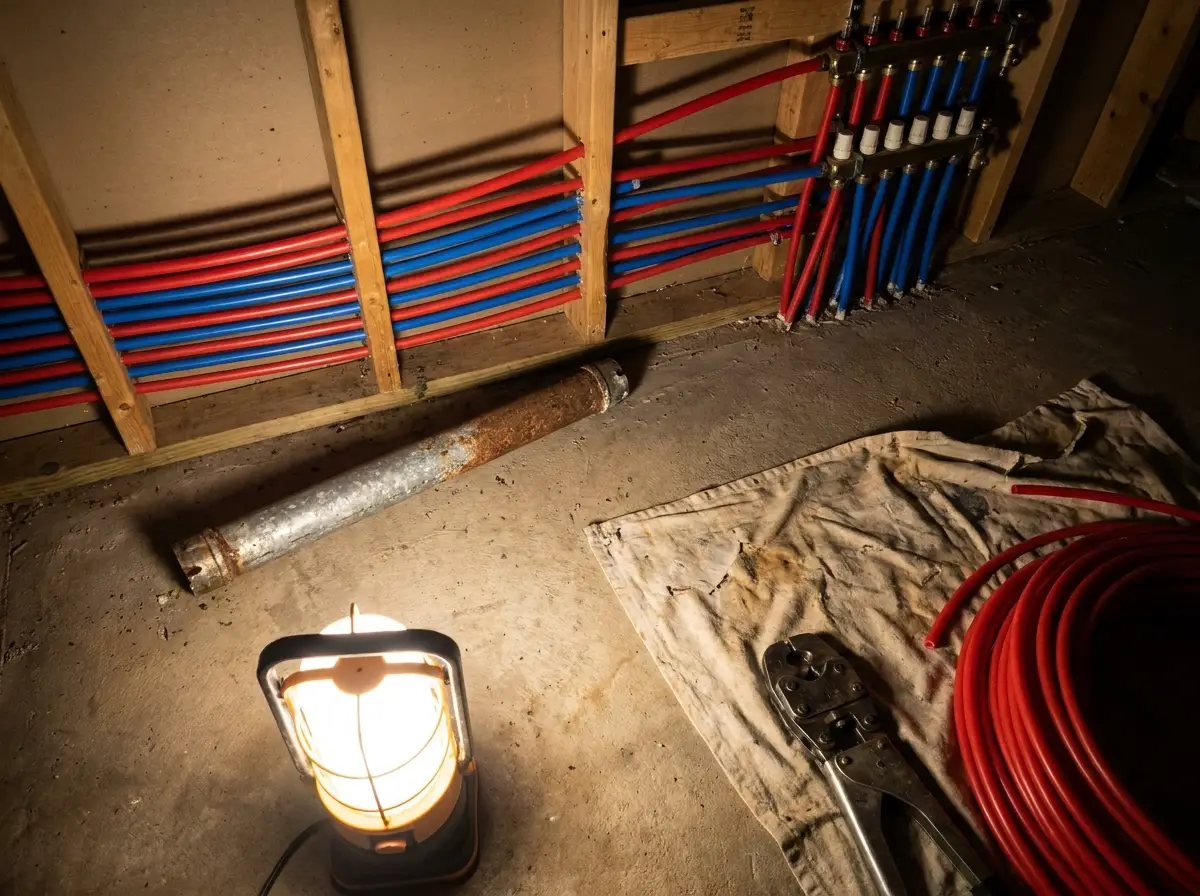
The inside pipe is a separate job from the service line. A whole-house repipe replaces the supply lines with new material. National cost guides put a whole-house repipe at $1,500 to $15,000, with an average near $7,500 (Angi repipe cost guide). Cost depends on the number of fixtures, how the house is built and how much wall and floor has to open up. A partial repipe, which replaces only the worst runs, costs less. The plumber cost page explains how a written quote is built.
Pipe materials and what they cost per foot
| Material | Typical cost per foot | Notes |
|---|---|---|
| PEX | $0.40 to $2 | Flexible plastic, often fits through walls with less opening |
| CPVC | $0.50 to $1 | Rigid plastic, joined with solvent |
| Copper | $2 to $8 | Long record, higher material cost |
Those are material costs from Angi, not the full job. Labor, drywall repair, permits and the number of fixtures drive the total. A plumber who quotes a repipe should name the material, the number of fixtures and who repairs the walls.
Living in the house during a repipe
A whole-house repipe usually means the water is off for part of a day or longer, with access holes cut in walls and ceilings. Ask the plumber how long the water will be off, whether a temporary supply will be set up and how the walls will be repaired. A partial repipe that only replaces the worst runs can be less disruptive. The process page shows how a job moves from quote to finished work.
Questions to ask for a repipe quote
- Which material will you use, and why that one for my house?
- Is the quote for the whole house or only the runs you saw?
- Does it include the permit, the wall repair and the water shutoff time?
- Will you check the service line at the same visit?
- What is the plan if the walls hold more old pipe than expected?
A written quote that covers these is easier to compare with a second one. If two quotes differ a lot, the difference is usually in what is included, not in the price per foot.
When to plan a repipe
- Rusty water that returns after flushing.
- Pressure that drops when two fixtures run.
- More than one leak in the same pipe run.
- A house or an addition that you plan to sell, remodel or finish.
Replacement work needs a permit. The City of Beloit requires one before any plumbing work, so call Planning and Building Services at (608) 364-6700 to confirm what your job needs (City permit page). Send the age of the house and what you see through the quote form and a licensed plumber can say how far the galvanized runs.
Sources: U.S. Census Bureau, ACS 2020-2024 5-year, table B25034, via Census Reporter; City of Beloit 2024 Consumer Confidence Report; City of Beloit, lead service line notice; City of Beloit, $6.36 million for private-side lead service lines; Wisconsin PSC, lead service line totals from 2025 annual reports; Angi, cost to repipe a house; City of Beloit, Planning and Building Services permits
Want a price for your own house?
Call, text, or send the form. You get a price back before any work is scheduled.
Quick answers
How do I know if I have galvanized pipes?
Galvanized pipe is dull gray steel with threaded fittings, and a magnet sticks to it. Copper looks coppery when scratched, and plastic is not magnetic.
How many galvanized service lines does Beloit have?
The PSC 2025 annual report lists 1,966 galvanized customer-side service lines in the Beloit Water Utility, plus 12,662 lines of unknown material, on a total of 16,362 customer-side lines.
Does the City require me to replace galvanized pipe?
The City says that if a home has lead or galvanized pipes, the federal government is requiring those to be replaced within the next 10 years. Call (608) 364-5735 to identify your pipe.
How much does it cost to repipe a house?
National cost guides put a whole-house repipe at $1,500 to $15,000, depending on fixtures and access. See the cost page for how quotes are built.
Why is my water brown?
Rust from galvanized pipe is a common cause, especially after the water sits unused. A plumber can tell whether the rust is in your pipe or comes from the main.
How old are homes in Beloit?
The median year built for Beloit homes is 1957, and 55% were built before 1960, based on Census data.
Want a plumber to look at it?
Describe the problem and the town. A licensed plumber replies with a price before any work starts.
Prices and the full service list are on the homepage for a plumber in Beloit.